Exploring Indian Identity Through Thota Vaikuntam’s Brushstrokes
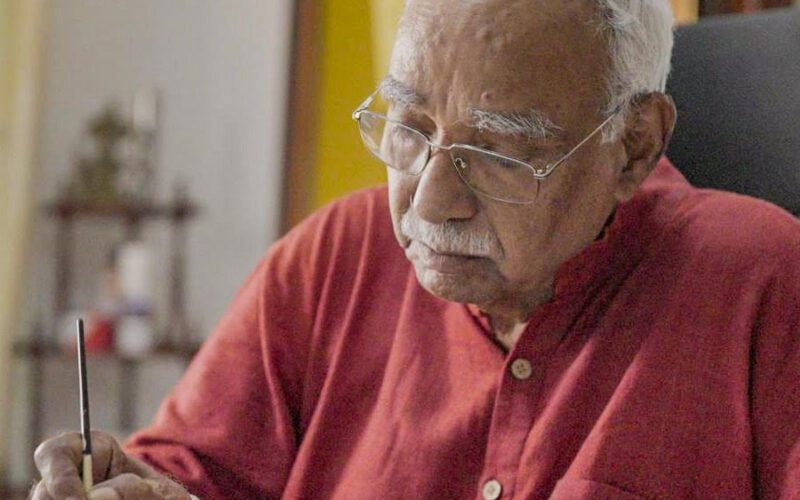
India’s art is huge, varied and fixed in the ways of each place and community. Many painters move between village life and city taste – yet Thota Vaikuntam does it with special clarity. His pictures are not just shapes on cloth – they speak plainly about how villagers live, love and pray. Bright reds glowing yellows but also firm black lines show Telangana’s fields, women and men exactly as he sees them.
The Artist and His Origins
Thota Vaikuntam was born in the tiny village of Boorugupalli in Telangana. As a boy he saw women in blazing saris, earth coloured fields and noisy village festivals. Those sights stayed in his mind plus later filled every picture he painted.
Thota Vaikuntam never aimed for showy spectacle or vague ideas – he simply looked at the neighbours he grew up with and set down what he saw. Telangana farmers, housewives but also musicians stand in his pictures, heads high, faces steady, bodies calm. A woman presses red sindoor into her hair parting – a labourer leans on his hoe and rests – a drummer hugs his dappu to his chest and beats the skin. Ordinary acts – yet the paint as well as posture tell the viewer – those people know who they are and they value their place.
Depicting the Soul of Rural India
Thota Vaikuntam paints in a way that no one else does because he keeps his eyes on the red earth and the men and women who walk it in Telangana. He puts the place itself on the canvas – the soil that cracks in summer, the saris that flame against that soil, the look in a woman’s eyes when she carries a water pot home at dusk.
Women sit at the heart of almost every picture. A red sari wraps one like a banner, a yellow cloth catches the sun on another, a green drape flashes between them. The colors shout – yet the women stay steady – they are handsome and they endure.
No one face copies a photograph. The eyes tilt up at the outer corners like two long almonds, the nose juts forward, the mouth sits firm. You read joy, doubt, weariness, pride – you feel blood and breath behind the flat paint. Those people are not marble gods or textbook goddesses – they draw water, sweep courtyards, scold children, sell bangles. Vaikuntam picks those moments, pins them to wood and hands them back to the nation as quiet flags of identity.
When you stand in front of one of his works you see India’s older pulse still beating – respect for what elders planted, delight in a plain day, the tug between a farmer and his field. The painting acts like a mirror – it shows the viewer where the country began and where it still stands when the noise dies down.
Color as a Language of Identity
Color is central to Vaikuntam’s paintings. He picks strong plain colours – brick red, mustard yellow, mud brown and leaf green. Those shades mirror the everyday look of the countryside – sun baked earth, ploughed fields, turmeric powder and the bright saris women wear in small towns.
Each colour holds a clear feeling. Red stands for life and for prayer – yellow points to happiness and to faith – black lines hold the picture together and give it firm edges. Side by side the colours beat like drums and pull the eye into a scene that feels private yet plainly Indian.
Vaikuntam does not use paint only to please the eye – he treats it as speech. With those hues he records the beat of Indian days – festival drums, dusk in a lane, people and trees living side by side without clash.
From Folk Art to Fine Art: Bridging Two Worlds
Thota Vaikuntam’s main strength is that he puts plain village looks together with today’s ways of painting. He borrows from old temple wall pictures and leather puppets – yet he places the people and shapes on the canvas the way a modern viewer expects.
Because of that mix, the pictures do not seem tied to one year or fashion. The heart of the village stays honest, while clean lines and careful drawing keep the work inside the world of serious art. The men and women stand still, almost like clay statues, quiet and steady, the way life runs in a small settlement. Yet the lack of movement holds quiet tales – trust in God, fondness for a partner, daily work and the sense that one belongs.
With such pictures Vaikuntam lays a firm plank between the hamlet and the city, between yesterday and this day. The paintings say that who you are does not stop at a field boundary or at a date on a calendar – it keeps moving forward when people stay linked to their roots but also hold their culture up with pride.
Recognition and Legacy
Over the years people in India and other countries have praised the paintings of Thota Vaikuntam. Crowds of buyers reviewers and fans attend his shows because they feel his pictures show the real spirit of Indian life. He gives more than skill to Indian art – he saves a daily life that fast changing times tend to ignore.
When he reached the middle of his career, the gallery called ArtAlive began to show his work plus carried bright pictures of Telangana village life to viewers across the world. Thanks to those shows, people keep talking about why it matters to hold on to local culture while the world modernizes.
The Symbolism Behind the Figures
The people in Vaikuntam’s pictures do more than look attractive – they carry plain cultural weight. The women stand for toughness and for the way life goes on – they hold families and customs together. The men stay quiet and keep to brown and ochre colours – they show steadiness and the will to last.
The chains on their arms, the folds of their saris and dhotis, the way a hand rests on a hip all point to three plain things – prayer, work and the answer to the question “Who am I?” Today many artists strip shapes down to dots and lines – Vaikuntam keeps the picture close to real life and fills it with village spirit.
His canvases say that to stay modern you need not throw the past away – you walk forward and take the past with you. When he paints a field labourer or a girl at a well he paints them as they are – yet he sets them on a level with national heroes. They become simple lasting faces of India, faces that stay alive under new roads, new phones, new towns.
Global Appreciation and Cultural Relevance
The reason Vaikuntam’s pictures feel familiar everywhere is that they tell the plain truth. The men and women he paints live in Indian villages – yet the feelings they carry – love, pride, faith and the will to keep going – belong to everyone. Buyers from other countries look at the canvases and see real Indian countryside – no advertising tricks, no fake charm.
While new Indian art travels farther and farther, painters like Thota Vaikuntam act as quiet guides. His work tells the world that India draws power not only from fast growing cities but also from its villages and from the men and women who keep old customs alive.
Conclusion:
Thota Vaikuntam paints pictures that show who we are. His brush marks speak of prayer, plain living and pride in our ways – the very threads that hold India together.
In a world where outside habits mix and muddle local life, Vaikuntam keeps his colors bright and his lines firm. Every cloth he stretches shouts that paint fixes memory, sings old song and gives new shape to the self.
When you look through his eyes, India turns into one wide cloth that pulses with red, black but also gold – it feels, it breathes and it never ages.

Samar
Punsuniverse — a realm crafted by me, Samar! You will find everything here that is related to puns, weather its food, animals, names or something elsse.